
Search Shortcut cmd + k | ctrl + k
- Installation
- Documentation
- Getting Started
- Connect
- Data Import and Export
- Overview
- Data Sources
- CSV Files
- IO
- JSON Files
- Overview
- Creating JSON
- Loading JSON
- Writing JSON
- JSON Type
- JSON Functions
- Format Settings
- Installing and Loading
- SQL to / from JSON
- Caveats
- Multiple Files
- Parquet Files
- Partitioning
- Appender
- INSERT Statements
- Lakehouse Formats
- Client APIs
- Overview
- ADBC
- C
- Overview
- Startup
- Configuration
- Query
- Data Chunks
- Vectors
- Values
- Types
- Prepared Statements
- Appender
- Table Functions
- Replacement Scans
- API Reference
- C++
- CLI
- Overview
- Arguments
- Dot Commands
- Output Formats
- Editing
- Friendly CLI
- Safe Mode
- Autocomplete
- Syntax Highlighting
- Known Issues
- Go
- Overview
- Connect
- Import Data
- Run Queries
- Handle Results
- Write User Defined Functions
- Profile and Monitor
- Troubleshoot
- Java (JDBC)
- Overview
- Connect
- Import Data
- Run Queries
- Handle Results
- Write User Defined Functions
- Profile and Monitor
- Deploy as Native Image
- Troubleshoot
- Node.js (Neo)
- ODBC
- Python
- Overview
- Data Ingestion
- Conversion between DuckDB and Python
- DB API
- Relational API
- Function API
- Types API
- Expression API
- Spark API
- API Reference
- Known Python Issues
- R
- Rust
- Overview
- Connect
- Import Data
- Run Queries
- Handle Results
- Write User Defined Functions
- Profile and Monitor
- Troubleshoot
- Wasm
- Tertiary Clients
- SQL
- Introduction
- Statements
- Overview
- ANALYZE
- ALTER TABLE
- ALTER VIEW
- ATTACH and DETACH
- CALL
- CHECKPOINT
- COMMENT ON
- COPY
- CREATE INDEX
- CREATE MACRO
- CREATE SCHEMA
- CREATE SECRET
- CREATE SEQUENCE
- CREATE TABLE
- CREATE VIEW
- CREATE TYPE
- DELETE
- DESCRIBE
- DROP
- EXPORT and IMPORT DATABASE
- INSERT
- LOAD / INSTALL
- MERGE INTO
- PIVOT
- Profiling
- PREPARE, EXECUTE, and DEALLOCATE
- SELECT
- SET / RESET
- SET VARIABLE
- SHOW and SHOW DATABASES
- SUMMARIZE
- Transaction Management
- UNPIVOT
- UPDATE
- USE
- VACUUM
- Query Syntax
- SELECT
- FROM and JOIN
- WHERE
- GROUP BY
- GROUPING SETS
- HAVING
- ORDER BY
- LIMIT and OFFSET
- SAMPLE
- Unnesting
- WITH
- WINDOW
- QUALIFY
- VALUES
- FILTER
- Set Operations
- Prepared Statements
- Data Types
- Overview
- Array
- Bitstring
- Blob
- Boolean
- Date
- Enum
- Geometry
- Interval
- List
- Literal Types
- Map
- NULL Values
- Numeric
- Struct
- Text
- Time
- Timestamp
- Time Zones
- Union
- Typecasting
- Variant
- Expressions
- Overview
- CASE Expression
- Casting
- Collations
- Comparisons
- IN Operator
- Logical Operators
- Star Expression
- Subqueries
- TRY
- Functions
- Overview
- Aggregate Functions
- Array Functions
- Bitstring Functions
- Blob Functions
- Date Format Functions
- Date Functions
- Date Part Functions
- Enum Functions
- Geometry Functions
- Interval Functions
- Lambda Functions
- List Functions
- Map Functions
- Nested Functions
- Numeric Functions
- Pattern Matching
- Regular Expressions
- Struct Functions
- Text Functions
- Time Functions
- Timestamp Functions
- Timestamp with Time Zone Functions
- Union Functions
- Utility Functions
- Window Functions
- Constraints
- Indexes
- Meta Queries
- DuckDB's SQL Dialect
- Overview
- Indexing
- Friendly SQL
- Keywords and Identifiers
- Order Preservation
- PostgreSQL Compatibility
- SQL Quirks
- PEG Parser
- Samples
- Configuration
- Extensions
- Overview
- Installing Extensions
- Advanced Installation Methods
- Distributing Extensions
- Versioning of Extensions
- Troubleshooting of Extensions
- Core Extensions
- Overview
- AutoComplete
- Avro
- AWS
- Azure
- Delta
- DuckLake
- Encodings
- Excel
- Full Text Search
- httpfs (HTTP and S3)
- Overview
- HTTP(S) Support
- Hugging Face
- S3 API Support
- S3 and AWS Authentication
- Legacy Authentication Scheme for S3 API
- Iceberg
- ICU
- inet
- jemalloc
- Lance
- MotherDuck
- MySQL
- ODBC
- Quack
- PostgreSQL
- Spatial
- SQLite
- TPC-DS
- TPC-H
- UI
- Unity Catalog
- Vortex
- VSS
- Quack Remote Protocol
- Guides
- Overview
- Data Viewers
- Database Integration
- File Formats
- Overview
- CSV Import
- CSV Export
- Directly Reading Files
- Directly Reading DuckDB Databases
- Excel Import
- Excel Export
- JSON Import
- JSON Export
- Parquet Import
- Parquet Export
- Querying Parquet Files
- File Access with the file: Protocol
- Meta Queries
- Describe Table
- EXPLAIN: Inspect Query Plans
- EXPLAIN ANALYZE: Profile Queries
- List Tables
- Summarize
- DuckDB Environment
- Network and Cloud Storage
- Overview
- HTTP Parquet Import
- HTTP CSV Import
- S3 Parquet Import
- S3 Parquet Export
- S3 Iceberg Import
- S3 Express One
- GCS Import
- Cloudflare R2 Import
- DuckDB over HTTPS / S3
- Share a Views-Only Database
- Fastly Object Storage Import
- SeaweedFS Import
- Tigris Import
- ODBC
- Performance
- Overview
- Environment
- Import
- Schema
- Indexing
- Join Operations
- File Formats
- How to Tune Workloads
- My Workload Is Slow
- Out-of-Memory Issues
- Benchmarks
- Working with Huge Databases
- Python
- Installation
- Executing SQL
- Jupyter Notebooks
- marimo Notebooks
- SQL on Pandas
- Import from Pandas
- Export to Pandas
- Import from Numpy
- Export to Numpy
- SQL on Arrow
- Import from Arrow
- Export to Arrow
- Relational API on Pandas
- Multiple Python Threads
- Integration with Ibis
- Integration with Polars
- Integration with PyTorch
- Using fsspec Filesystems
- SQL Editors
- SQL Features
- AsOf Join
- Full-Text Search
- Graph Queries
- query and query_table Functions
- Merge Statement for SCD Type 2
- Timestamp Issues
- Snippets
- Creating Synthetic Data
- Dutch Railway Datasets
- Sharing Macros
- Analyzing a Git Repository
- Importing Duckbox Tables
- Copying an In-Memory Database to a File
- Calculating a Database Checksum
- Troubleshooting
- Glossary of Terms
- Browsing Offline
- Operations Manual
- Overview
- DuckDB's Footprint
- Installing DuckDB
- Logging
- User Agents
- Securing DuckDB
- Non-Deterministic Behavior
- Limits
- DuckDB Docker Container
- Development
- DuckDB Repositories
- Release Cycle
- Metrics
- Profiling
- Building DuckDB
- Overview
- Build Configuration
- Building Extensions
- Android
- Linux
- macOS
- Raspberry Pi
- Windows
- Python
- R
- Troubleshooting
- Unofficial and Unsupported Platforms
- Benchmark Suite
- Testing
- Internals
- Sitemap
- Live Demo
Syntax Highlighting
Syntax highlighting in the CLI is currently only available for macOS and Linux.
SQL queries that are written in the shell are automatically highlighted using syntax highlighting.
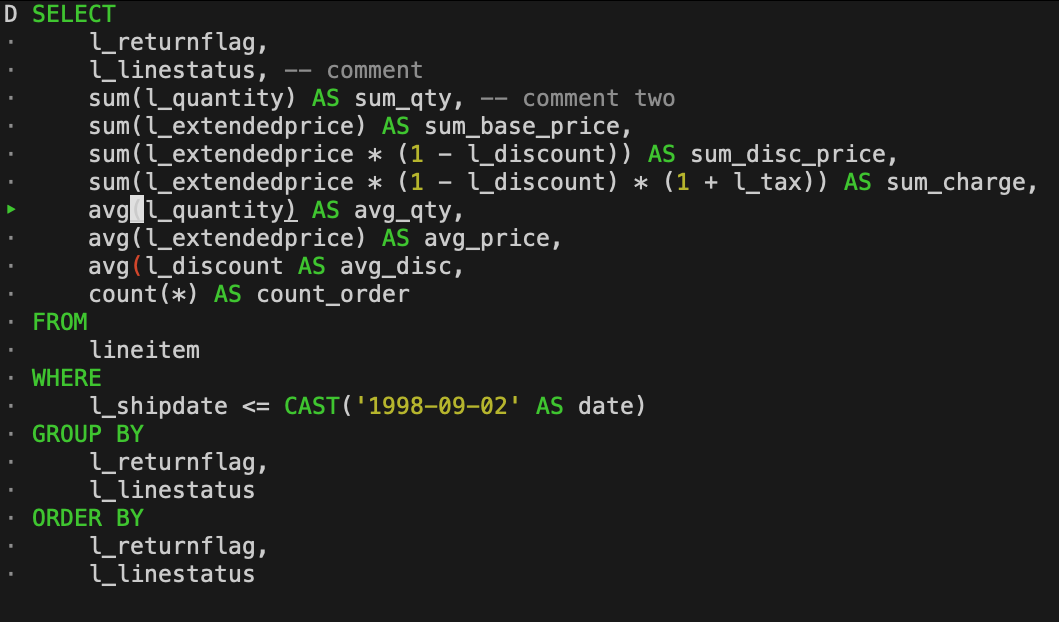
There are several components of a query that are highlighted in different colors. The colors can be configured using the .highlight_colors dot command:
Syntax highlighting can also be disabled entirely using the .highlight off command.
Below is a list of query components that can be configured.
| Type | Component | Default color |
|————————-|————————-|—————|
| Keywords | keyword | green |
| Numeric constants | numeric_constant | yellow |
| String constants | string_constant | yellow |
| Comments | comment | gray |
| Errors | error | red |
| Continuation | continuation | gray |
| Continuation (Selected) | continuation_selected | green |
Colors are specified by name. The following basic colors are supported by all terminals:
black, red, green, yellow, blue, magenta, cyan, brightgray, gray, brightred, brightgreen, brightyellow, brightblue, brightmagenta, brightcyan, white
In addition, 8-bit colors can be used. Run .display_colors to list all available color names, see 8-Bit Colors.
The optional intensity can be standard, bold, underline or bold_underline.
For example, here is an alternative set of syntax highlighting colors:
.highlight_colors keyword brightred bold
.highlight_colors numeric_constant white
.highlight_colors string_constant white
.highlight_colors comment cyan
.highlight_colors error yellow
.highlight_colors continuation blue
.highlight_colors continuation_selected brightblue
If you wish to start up the CLI with a different set of colors every time, you can place these commands in the ~/.duckdbrc file that is loaded on start-up of the CLI.
Error Highlighting
The shell has support for highlighting certain errors. In particular, mismatched brackets and unclosed quotes are highlighted in red (or another color if specified). This highlighting is automatically disabled for large queries. In addition, it can be disabled manually using the .render_errors off command.
© 2026 DuckDB Foundation, Amsterdam NL